SpaceX brings space mining closer to our world
Within days of its IPO, SpaceX’s market value was pushing toward US$3 trillion, putting a public-market valuation on reusable rocket launches as the infrastructure layer for the next space economy — and, suddenly, space mining looks a little less out of this world.
The reason is that Elon Musk’s SpaceX reusable launch systems (reuseable rockets) have the potential to turn space into an industrial logistics chain.
SpaceX’s listing also points to asteroid mining as a future market, with reusable rockets, robotics and space processing potentially making it commercially viable.
Asteroids are key to mining in space. In particular, Iron and M-type (metallic asteroids), which are thought to be, basically, metal-rich rocks left over from the violent formation of planets — with ore grades thought to exceed terrestrial percentages — flying through the solar system, including:
- cobalt
- gold
- iron
- magnesium
- nickel
- palladium, platinum
- rhodium, ruthenium, iridium, osmium
For example, NASA’s Psyche mission is heading to a metal-rich asteroid whose surface contains substantial amounts of metal.
Research suggests some metallic asteroids may contain more than 1,000 times as much nickel as Earth’s crust, cobalt x300 more abundant, and iron 22 times more abundant.
Space Mining
In theory, there are no permitting worries or environmental concerns for mining companies on asteroids (although that may change). The challenge, instead, is logistics.
Space mining companies would first have to send prospecting spacecraft to near-Earth asteroids, identify composition, map rotation and surface conditions, then attempt anchoring, excavation, heating, magnetic separation or other extraction methods.
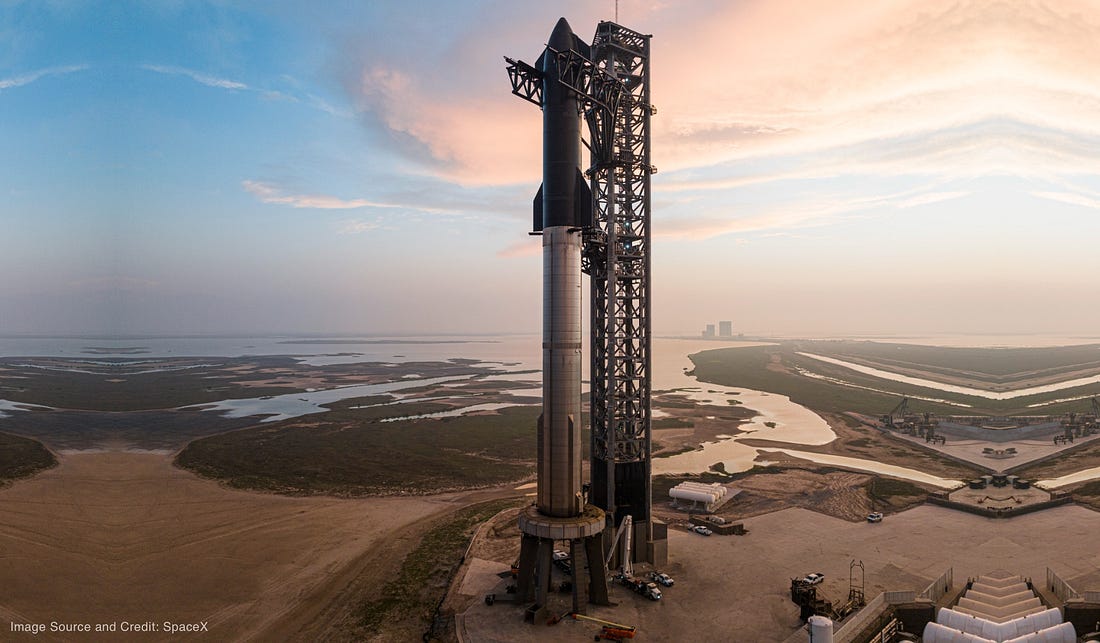
Reusable launch lowers the transport cost and logistics barrier significantly. For example, Elon Musk’s latest SpaceX Starship landing attempts to revolutionise rocket systems by making controlled landings, refueled quickly, and then launched back into space again and again — with capacity to carry more than a hundred tonnes to orbit in one go.
The case for space mining has two main drivers:
- supply security: platinum group metals, nickel, cobalt, tungsten and other advanced materials already sit inside fragile terrestrial supply chains, with falling grades and rising environmental concerns — all of which are driving up prices for mining on Earth
- rising demand: with the energy transition, data centers and AI, robotics, and re-industrialisation, demand for critical minerals is expected to rise significantly over the coming decades
For example, the IEA estimates global refined copper demand (excluding direct-use scrap) increases to almost 37Mt by 2050 (from 27Mt in 2024). All of which is driving up the costs of the metals themselves, making options such as mining in space increasingly economical.
The OSIRIS-REx was the first US mission to collect a sample from an asteroid, returning to Earth on Sept 24, 2023. Then, in 2023, NASA launched the Psyche mission to a “unique metal-rich asteroid orbiting the Sun between Mars and Jupiter… that it appears to be the exposed nickel-iron core of an early planet” — it is expected to reach its destination in 2029. Japan has also sent up ground-breaking missions to asteroids — Hayabusa and Hayabusa2 — to collect samples.
These latest missions prove sample return, but not industrial extraction.
NASA’s OSIRIS-REx mission returned material from Bennu in 2023, but the agency’s early curation milestone was just 70.3 grams of asteroid material, while the wider mission was reported at about US$1 billion.
That is science, not mining.
So, how much could space mining cost? Independent work on fully reusable launch systems has modelled costs could be US$300-400/kg, while Google’s Project Suncatcher analysis suggests some orbital infrastructure begins to make economic sense near US$200/kg.