Modern steelmaking is shifting away from its reliance on fossil fuels
The global steel industry has entered the most disruptive phase of its 3,000-year history. Driven by intense regulatory pressure to eliminate carbon emissions, a volatile scrap market, and new breakthroughs in hydrogen metallurgy, modern steelmaking is shifting away from its traditional reliance on fossil fuels.
Historically responsible for roughly 7% to 9% of all global greenhouse gas emissions, the industry is spending billions to transform how it turns iron ore into structural steel. The modern marketplace is split between optimization projects designed to make traditional coal-fired equipment more efficient and a massive wave of capital investment aimed at replacing coal entirely.
THE TWO PATHWAYS OF MODERN STEEL PRODUCTION
Pathway 1: Traditional Integrated Route
Iron Ore + Metallurgical Coal —> [ Blast Furnace (BF) ] —> Liquid Iron —> [ Basic Oxygen Furnace (BOF) ] —> Crude Steel
Pathway 2: Modern Decarbonized Route
Iron Ore + Hydrogen / Natural Gas —> [ Direct Reduction (DRI) ] —> Sponge Iron —> [ Electric Arc Furnace (EAF) ] —> Crude Steel
1. The Traditional Integrated Route: Blast Furnace / Basic Oxygen Furnace (BF-BOF)
The BF-BOF route remains the heavyweight champion of global production, accounting for approximately 70% of the world’s steel output. This method is optimized for massive, high-volume production but relies fundamentally on the chemistry of carbon.
The Ironmaking Stage (The Blast Furnace)
The blast furnace is a giant chemical reactor that runs continuously. It is fed from the top with iron ore (sinter or pellets), fluxes (limestone and dolomite), and coke (coal that has been baked in the absence of oxygen to remove impurities and leave pure carbon).
Preheated air (often enriched with oxygen) is blasted into the bottom of the furnace through nozzles called tuyeres, reaching temperatures over 2,000°C. This ignites the coke, creating Carbon Monoxide (CO), which acts as the chemical reducing agent. As the gases rise, they strip oxygen atoms away from the descending iron ore in a series of reduction steps:
The resulting liquid product, called hot metal or pig iron, is highly saturated with carbon (around 4–4.5%), which makes it brittle and unworkable.
The Steelmaking Stage (The Basic Oxygen Furnace)
To transform pig iron into tough, malleable steel, the carbon content must be slashed to under 1%. The liquid pig iron is transferred to a Basic Oxygen Furnace (BOF).
A water-cooled lance is lowered into the vessel, blasting pure oxygen at supersonic speeds onto the liquid metal bath. The oxygen reacts with the dissolved carbon, converting it into Carbon Dioxide (CO₂) gas, which vents away. Fluxes are added to combine with impurities like phosphorus and silicon, forming a liquid layer of slag that floats on top of the refined steel.
2. The Electric Arc Furnace (EAF) and the Scrap Bottleneck
Accounting for roughly 30% of global production, the Electric Arc Furnace represents the primary circular economy pathway for steel.
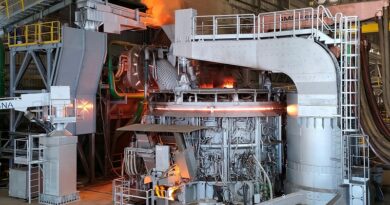
Instead of treating iron ore, a traditional EAF uses high-power electric currents to melt solid recycled steel scrap. Large carbon electrodes are lowered into the furnace, striking massive electrical arcs directly into the scrap pile to melt it at temperatures near 3,000°C.
Advantages:
– Emits up to 75% less CO2 than a blast furnace when powered by a clean electric grid.
– Highly flexible—can be turned on and off based on shifting power prices.
Disadvantages (The Scrap Quality Crisis):
– Copper and tin impurities from old cars and appliances easily contaminate scrap steel.
– High-end automotive and aerospace sheets cannot tolerate these impurities, limiting EAFs from producing premium steel grades without blending in virgin iron.
3. The Green Horizon: DRI and Hydrogen Metallurgy
To bypass the scrap quality crisis and eliminate the carbon footprint of blast furnaces, the industry is pivoting toward Direct Reduced Iron (DRI) paired with EAFs.
Direct Reduced Iron (DRI)
Unlike a blast furnace, which melts ore to separate iron, a DRI reactor operates below the melting point of iron (around 800°C to 1,050°C). It feeds solid iron ore pellets into a shaft furnace, using a reducing gas to strip away oxygen without liquefying the metal. The output is a highly porous, solid material known as sponge iron or Direct Reduced Iron.
The Shifting Gas Chemistry: Natural Gas vs. Pure Hydrogen
The Natural Gas Baseline (Midrex/Energiron): Most operating DRI plants use reformed natural gas (CH₄), which yields a mix of Carbon Monoxide (CO) and Hydrogen (H₂). While it still produces CO₂, it reduces the carbon intensity by up to 40-50% compared to a blast furnace.
The Pure Hydrogen Holy Grail (H2-DRI): The cutting edge of modern steelmaking replaces natural gas completely with Green Hydrogen produced via water electrolysis powered by renewable energy.
When pure hydrogen reacts with iron ore, the only chemical byproduct is water vapour. The solid sponge iron is then discharged directly into an adjacent EAF, where it is melted and alloyed into premium, zero-carbon steel grades.